Meat Thermometer for Turkey: Target Temps for the Bird, Breast and Parts
We may earn a commission from Amazon links. How we choose
Updated · By Rouuo Editorial Team · How we test ↓
Table of Contents
Ask AI
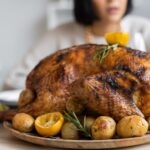
Using a meat thermometer in turkey comes down to one number: 165°F, and it is the same for the whole bird, the breast, the thighs, and ground turkey. What makes turkey hard is not the number, it is that a single reading will lie to you. On a whole bird the breast and the thighs finish 10 to 20 degrees apart, and it is easy to hit bone and get a false high. So you check more than one spot, and you pull the bird before the breast reaches 165°F, letting carryover finish it while it rests. This guide covers the target temps by part, the three places to check on a whole bird, how to pull early so the breast stays juicy, and which meat thermometer type suits a multi-hour roast.
Our pick for turkey
Typhur Sync
Wireless probe with 6 internal sensors and a WiFi-bridged base station, so you can follow a long cook from anywhere in the house.
On a budget: ThermoPro TempSpike. Wireless dual-sensor probe with a 500 ft Bluetooth range, for much less money.
Turkey Temperature Chart
165°F is a food-safety minimum for every part. The pull temps below build in carryover so the breast does not dry out.
| Part or cut | USDA safe temp (°F / °C) | Pull temp | Note |
|---|---|---|---|
| Whole bird (measured in the breast) | 165°F / 74°C | 157 to 160°F | Rest 30 to 45 min to reach 165°F. The breast is the limiting factor for juiciness |
| Breast, cooked separately | 165°F / 74°C | 160 to 162°F | Rest 15 to 20 min |
| Thighs and legs | 165°F / 74°C minimum | 175 to 185°F | Dark meat is more tender and juicy at the higher end, and safe well past 165°F |
| Ground turkey (burgers, meatballs) | 165°F / 74°C | 165°F | No early-pull adjustment. Ground meat cooks evenly |
| Stuffing cooked inside the bird | 165°F / 74°C | 165°F | Must reach 165°F in the center of the cavity, which usually means overcooking the breast |
165°F is a safety line, not a preference range the way beef doneness is. But the breast benefits from being pulled early and finished by carryover, while the thighs are better cooked past the minimum.
Where to Check a Whole Turkey: The Three Points
A whole bird needs three readings, because one spot cannot tell you the whole bird is safe.
The breast can read 165°F while the inner thigh is still at 150°F, and hitting the thigh bone or the joint bone gives a false high that hides an undercooked pocket. Ignore the pop-up timer that comes in a supermarket bird, too: those trigger around 178 to 185°F, well past the point the breast has dried out. For the full walkthrough with insertion angles and depth, see our guide on how to put a meat thermometer in a turkey.
How to Pull the Bird Early So the Breast Stays Juicy
Carryover on a whole roasted turkey is large, 5 to 10°F and sometimes more on a big bird, because a 14-pound-plus roast holds a lot of residual heat.
Pull the whole bird when the breast reads 157 to 160°F. The thighs will be around 165 to 170°F at that point, which is where you want them. Rest the bird uncovered or loosely tented for 30 to 45 minutes; the breast will climb into the 165°F safe zone during the rest, and the juices redistribute instead of running out when you carve.
If the thighs are lagging badly, with the breast at 160°F and the thighs still at 150°F, tent the breast with foil and give the bird another 15 to 20 minutes. Or spatchcock next time: removing the backbone and flattening the bird collapses the breast-versus-thigh gap to a few degrees and cuts roast time by about a third, which turns the whole thing into a single, less fussy temperature check.
Which Thermometer Type to Use for Turkey
A leave-in oven-safe probe is the right primary tool for a whole turkey. The roast runs 2 to 4 hours, and a leave-in probe in the breast with a target alarm means you are not opening the oven and dropping 25°F of heat every time you want to check progress.
A wireless leave-in probe is even better for a holiday cook. You can step away from the kitchen for an hour and get an alert on your phone when the breast hits your pull temp. Our wireless roundup covers those.
Keep a fast instant-read on hand as well, for the final three-point check across breast, thigh, and joint just before you pull the bird. One leave-in probe only tells you about one spot. Accuracy matters here more than any other cook of the year: a thermometer that reads low has you overcook the bird chasing a number it already passed, and one that reads high has you serve undercooked poultry, so test a new thermometer before the big day. Our full roundup covers tested leave-in and instant-read picks, and our guide to using a meat thermometer covers placement on every cut.
Resting and Carving Temperature
Rest a whole turkey 30 to 45 minutes before carving. That is long enough for carryover to bring the breast from around 158°F to a safe 165°F and for the juices to set. A turkey holds heat so well that a 45-minute rest still leaves it hot for serving, so you have more slack than you would with a steak.
Do not carve straight out of the oven. The breast is still climbing, and cutting early both stops that climb and floods the board with juice the meat should keep. Ground turkey and turkey burgers get a short 3 to 5 minute rest and are pulled at the full 165°F with no early-pull adjustment.
Frequently asked questions
What temperature should turkey be cooked to?
165°F (74°C) is the USDA safe minimum for every part. Pull a whole bird when the breast reads 157 to 160°F and let carryover finish it during a 30 to 45 minute rest. Cook thighs to 175 to 185°F for better texture.
Where do you put the meat thermometer in a turkey?
Three spots on a whole bird: the thickest part of the breast, the innermost thigh, and the joint where the thigh meets the body, each time avoiding bone. The joint is the slowest to reach temperature, so it is the one that confirms the bird is safe.
Is turkey done at 165 in the breast but 150 in the thigh?
No. The whole bird is not safe until the slowest spot, the inner thigh and joint, reaches 165°F. If the breast is ahead, tent it with foil and keep roasting until the thigh catches up.
Do I need to check the temperature of the stuffing?
Yes, if you stuff the bird. The center of the stuffing must reach 165°F, which usually means overcooking the breast to get there. Baking the stuffing in a separate dish avoids the problem entirely.
Can you use a leave-in probe for a whole turkey?
Yes, and it is the best tool for it. Set the alarm to your breast pull temp and leave the probe in for the whole roast. Add a quick instant-read three-point check right before you pull the bird.
Typhur Sync: Wireless probe with 6 internal sensors and a WiFi-bridged base station, so you can follow a long cook from anywhere in the house.
Get the right thermometer before the holiday
Turkey has one safe number, 165°F, but you check it in three places on a whole bird and you pull the breast early so carryover finishes it without drying it out.
See also our wireless roundup for a hands-off holiday cook, the full placement guide, temps for chicken, or the full doneness chart.